Skip to content
Wichita Falls Foundation

Serving Wichita Falls and nearby areas

Sinking Foundation in Wichita Falls, TX

A sinking foundation in Wichita Falls usually means one part of the house has dropped as the clay under it dried or washed out, and a free inspection measures how far it went and what will hold it.

Book a free foundation inspection

Tell us what you are seeing. A local specialist calls you back the same business day.

Local to Wichita Falls

We connect property owners in Wichita Falls and nearby areas, including Floral Heights, Faith Village, Tanglewood, Burkburnett, Iowa Park and Electra, with one independent local foundation repair specialist.

  • Deep dry-season cracks

    USDA says Tillman soil can crack more than 4 feet deep when it dries. The ground under a corner can lose support in one hot summer.

  • Record heat on record

    Wichita Falls reached 100 degrees on 100 days in 2011, the first Texas city to do it.

  • Flood ground near the river

    A 2007 Wichita River flood put water in 167 Wichita Falls homes, according to the USGS. Low ground that floods can soften and settle.

What it costs

Typical published ranges for Wichita Falls. The contractor's written estimate is the price, and the inspection is free.

WorkTypical range
Foundation inspection and written estimateThrough Wichita Falls Foundation Free
Foundation repair in Wichita Falls, small to major $2,200 to $23,100
Piers, concrete or steel $1,000 to $3,000each
Helical piers $1,500 to $2,000each
Slab jacking a sunken section $500 to $1,900
Structural engineer report, if needed $300 to $2,000

See typical foundation repair prices in Wichita Falls

What you will notice

A sinking foundation rarely means the whole house drops evenly. One corner, one side or one wall goes down while the rest stays put. That uneven drop shows up as:

A corner that looks low

The slab edge at one corner shows less concrete than the others, or the brick line dips.

Cracks that point toward one spot

Wall, brick and tile cracks all seem to run toward the same corner.

Floors that slope toward one side

A ball rolls to the same part of the house in every room.

A gap at the top of the wall

Drywall pulls away from the ceiling on the low side.

A porch or patio pulling away

The step or slab no longer meets the house.

A chimney leaning out

The chimney footing sank on its own.

Doors that stick on one side of the house

The ones on the low side bind first.

Why foundations sink in Wichita Falls

Clay that dries and shrinks. USDA soil surveys list common subsoils around Wichita Falls, like Tillman and Kamay, at 35 to 50 percent clay. When that clay loses water, it shrinks and pulls away from the slab or the piers above it. USDA notes that Tillman soil can crack more than 4 feet deep in a dry spell. A corner that loses support that deep can drop.

Long, hot droughts. Wichita Falls averages about 28 days a year at 100 degrees or more, and 2011 brought 100 of them. From 2011 to 2015 the area was in a deep drought. The soil along the outside of a house dries first, so corners and edges often drop while the middle stays higher.

Then floods. In 2015 the city got 50.5 inches of rain after the drought. Soil that swells fast can lift one part while another part, still dry, lags behind. On low ground near the Wichita River and Holliday Creek, flooding can soak and soften the soil. The USGS reports a 2007 Wichita River flood put water in 167 homes.

Water and roots at one spot. A downspout that dumps at a corner, a leak under the slab or a big tree next to the house can make one spot shrink or swell more than the rest.

Fill soil. Some lots were built up with loose fill. If it was not packed well, it can settle under the weight of the house for years.

Cosmetic or urgent?

Probably normal settling:

  • Thin cracks in a newer home that showed up early and have not changed
  • A slight slope with no other signs

Worth an inspection soon:

  • Cracks that keep getting longer or wider
  • Floors that slope more each season
  • One corner or side that looks lower than the rest
  • Brick, porch or chimney pulling away

Call right away:

  • Cracks that open fast after a storm or a long dry spell
  • A wall that leans or bulges
  • Doors or windows that suddenly will not open, which can block an exit

How it usually gets fixed

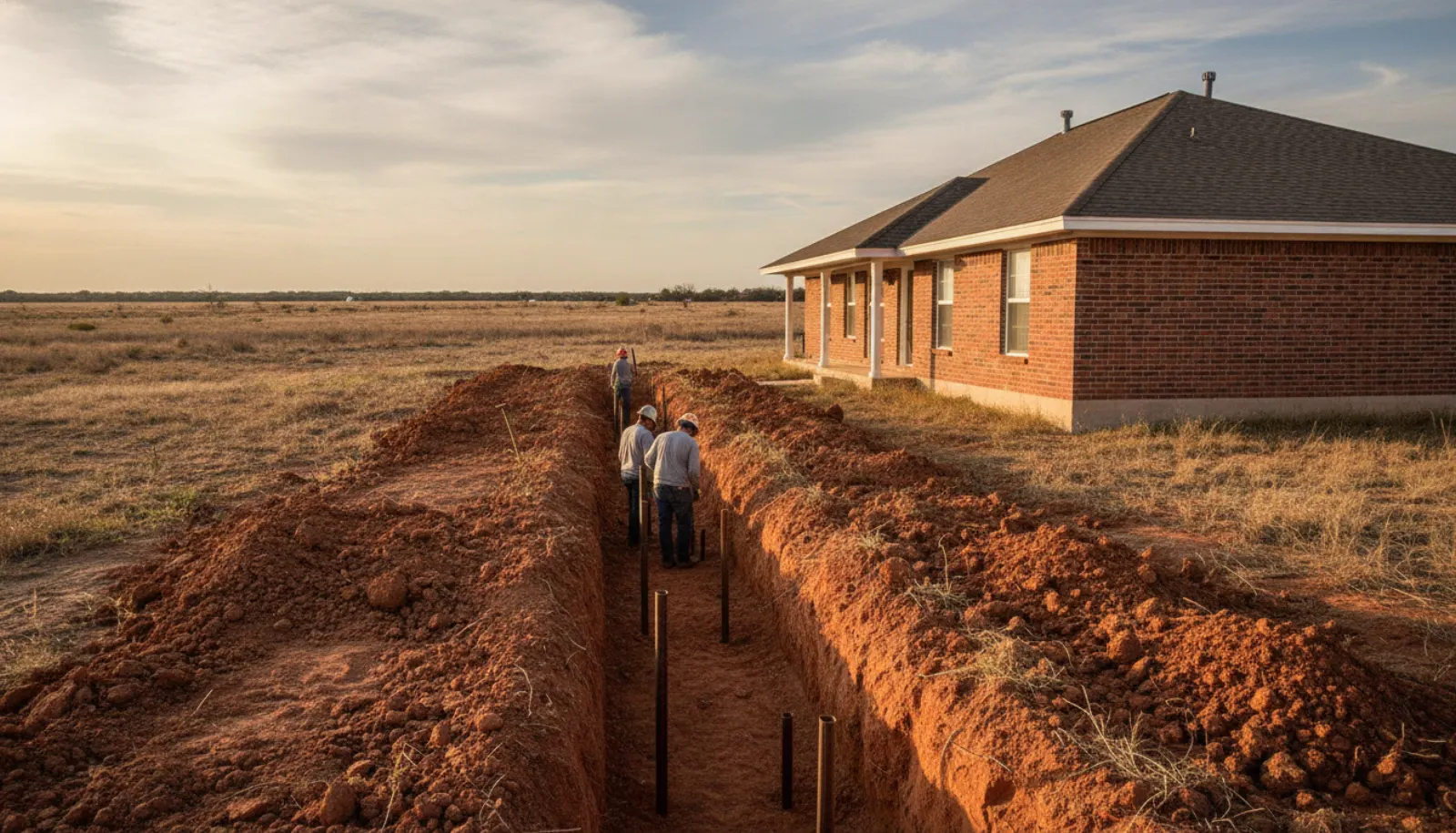
The standard fix is piers. The crew digs a small hole at the edge of the house where it sank, pushes piers down until they reach firmer ground, and lifts the house onto them. Steel shims and blocks hold it at the new height.

There are a few common kinds. Pressed concrete piers are short concrete pieces stacked and pushed in with a jack. Steel piers are pipe driven deeper, often used when firm ground is further down. Helical piers screw into the ground like a big auger. Published guides put most piers at about $1,000 to $3,000 each, and helical piers at about $1,500 to $2,000 each.

For a small sunken section of slab, like a patio or a garage floor, slab jacking pumps material under the concrete to raise it. Guides put that at about $500 to $1,900.

One cost guide puts foundation repair in Wichita Falls at about $2,200 to $23,100, depending on how much of the house sank. If water caused the sinking, the plan should fix the drainage too.

These are typical ranges, not quotes. Your price comes in writing after the free inspection.

What to do before the inspection

  1. Walk around the outside and look at how much slab shows at each corner.
  2. Take photos of cracks with a coin or ruler next to them.
  3. Mark the ends of the biggest cracks with a pencil and the date.
  4. Note where each downspout drains and where big trees sit.
  5. Write down when you first noticed the problem and what the weather was like.

Call (940) 468-1786 or send the short form. The inspector takes level readings across the whole house and shows you where it dropped and by how much.

Frequently asked questions

Is my house sinking or just settling?

Every house settles a little in its first years. Sinking is when one part keeps dropping more than the rest, year after year. Cracks that keep growing, floors that slope more each season and doors that get worse are signs it has not stopped.

Can a sinking foundation be fixed?

Yes. The usual fix is piers pushed down to firmer ground under the part that dropped. The house is lifted on those piers and held there. The goal is to stop the sinking and get the house back as close to level as is safe.

Will the house go all the way back to level?

Often close, but not always perfectly. Older homes may have bent framing or brick that would crack if forced all the way back. A good crew lifts to a safe point and tells you why.

How long does it take?

Most home pier jobs take one to three days. Bigger jobs, inside piers or drainage work can take longer. Your written estimate should list the schedule.

Do I have to move out?

Usually not. Most piers go in from outside, along the edge of the house. Inside piers are noisier and messier, and the crew will explain before they start.

Can I just wait and see?

You can track it, but sinking rarely stops on its own while the cause is still there. Waiting often means more piers, more cracks to patch and a bigger bill. A free inspection costs nothing and tells you how fast it is moving.

(940) 468-1786 Free inspection